


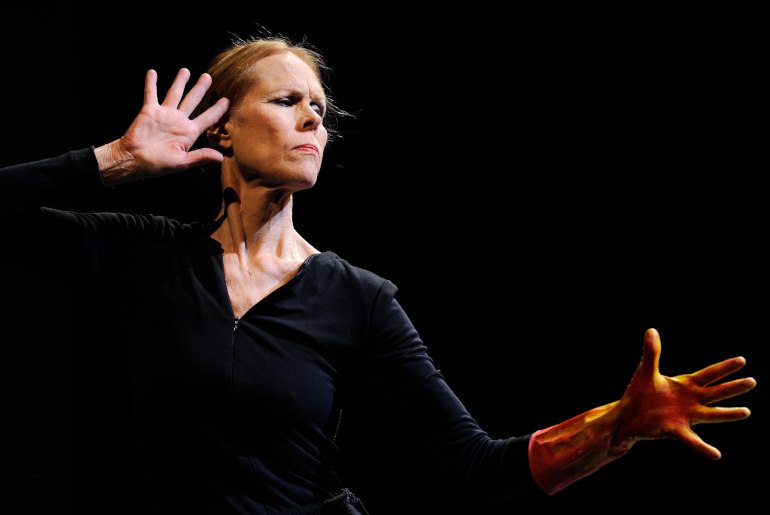
The return of the Carolyn Carlson Company to Genoa, after a long absence, stands out not only as one of the pivotal moments of the 2025 edition of “Resistere e Creare”, the international dance festival curated by the Fondazione Luzzati Teatro della Tosse and now in its eleventh year under the direction of Marina Petrillo, but also as a symbolically charged and culturally coherent event.
It was back in 1982, in fact, that Carolyn Carlson made her Genoese debut, performing “Underwood” at Teatro Alcione in collaboration with GOG, setting the tone for the Tosse’s now longstanding international vocation.
More than forty years later, Carlson returns to the Genoese stage with “Islands”, a triptych of solos built around a thematic core that weaves together elements of nature, inner drift, and instinctual tension. The work’s choreographic dramaturgy resists linear narrative in favour of evocation. For the American-born, French-naturalised choreographer, gesture does not explain: it suggests, traverses, questions. Each piece – including the Italian premiere of “A Deal with Instinct” – emerges as a poetic island, a micro-geography of feeling that demands not understanding, but openness from the viewer.
A key figure in European contemporary dance, Carolyn Carlson has shaped and been shaped by some of the most significant institutions and moments of the choreographic landscape in the latter half of the twentieth century – from the Opéra de Paris to the Venice Biennale, from La Fenice to the Théâtre de la Ville. Her approach – merging Eastern philosophy, secular spirituality, and a vision of movement as poetic and calligraphic act – has yielded a language of dense silences, inner rhythms, and bodies inscribed with meaning. It is a dance language, rooted in the teaching of her great mentor Alwin Nikolais, that translates the flow of existence into a form that is open, visionary, and inspiring.
On the eve of Islands’ Genoese premiere, we had the privilege of speaking with Carolyn Carlson. The conversation that follows offers an intimate and contemplative portrait of an artist who continues to question time, the human, and the gesture with the same clear urgency of someone who has never stopped searching. And who, even today, moves between the many faces of the self and the other, passing through the visible to graze the essential.
You are presenting “Islands” in Genoa, three different pieces that carry deep meaning. Would you tell us something more about it?
What’s always difficult for me is describing a piece. When I try, it’s never quite what it is. But I can give you some clues. Each dancer, each man, is totally different from the others. Riccardo’s solo – “The Seventh Man” – is based on a poem by a Hungarian poet. It talks about our many faces – pain, sorrow, joy, everything. And it speaks of the “seventh man” who, in the end, comes to terms with the consequences of his life. That was the inspiration. And I must say, I created the piece very much together with the dancers. They also improvised with me. We shaped the ideas together.
The second piece is “A Deal with Instinct”.
Very different. The dancer is Japanese. And it speaks specifically to the world we live in today. I feel we’re losing some of our instinct, everything is so polished, so perfected. The media tells you how to vote, what to do, everything. For me, it’s interesting to get back to our instincts, to our inner voice – just follow our lives.
And Tero Saarinen’s solo?
He’s Finnish. I’ve worked with him for years. The solo is called “Room 7”. And it’s about solitude: how we deal with it in the world. It started during COVID, when we were forced into isolation. But I think solitude is a good thing. We have to remember we are part of humanity, but at the same time we must acknowledge our solitude. We discover important things when we are alone. I come from the hippie generation, we didn’t have all this information. We had to go to the library, find space. I think these three solos say something about where we are today. But you can’t say too much, hopefully: the audience brings their own interpretations.
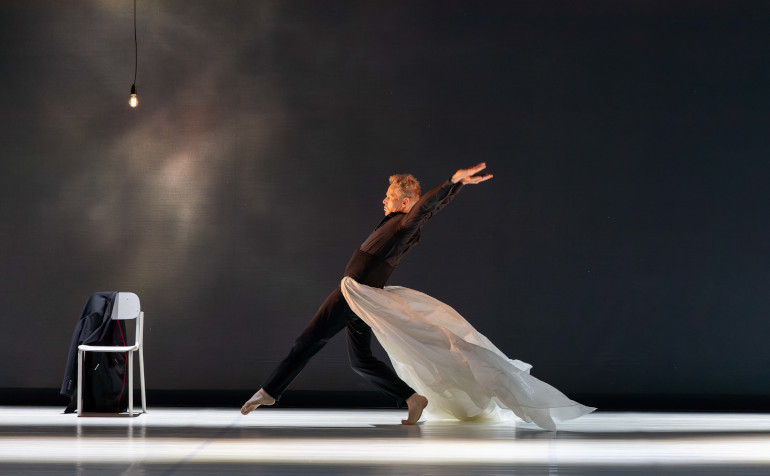

The solo seems to be one of your preferred forms. I’m thinking of “Blue Lady”, and other solos which you performed and later reinterpreted.
I like solos because you work in depth with one person. The focus is entirely there. When you have ten people on stage, the eye jumps around. But with a solo, it’s intimate and universal at the same time. We are alone in the world, and yet – we communicate. The audience brings their own perception. And I love that: perception more than emotion.
Do you think the fact that they’re all men changes anything? Or might it be read differently by the audience?
This is my point. I work with poetry – there’s no story. Great poetry, whether in French, English, or Italian, is always open. You can interpret it in many ways. I love haiku: they’re so short, but the last line always says something powerful. Today we are overwhelmed by information and explanations. But poetry is contemplation. Some viewers may take away nothing. Others, everything. It depends on their life, on what they see. Especially with dance, there are no words. It’s visual. That’s why I call it visual poetry. It’s visual energy.
“Visual poetry” is also your signature, isn’t it?
Yes. Before I start a creation, I sketch, or I gather poems – my own or others. I love poetry because it’s enigmatic.
You have a deep connection with Italy. Many see your leadership at La Fenice in the early 1980s as pivotal for the birth of contemporary dance in Italy, alongside Sosta Palmizi and what followed. After influencing Italian dance so much, did Italy in turn influence you?
Absolutely. I come from Nikolais, abstract concepts like time, space, shape, motion. But when I arrived in Italy, something different was happening. I lived in Venice. Venice is like no other place in the world. The water… it opened something. Italian dance was very responsive. Italians have something profoundly ancient—I don’t know if it’s history or culture. Four Italians are in my company. Sara Orselli has been with me for 24 years. Italians are like a family. They search together, discover new sources together. At La Fenice we worked every day from 10 to 5. We had a proper stage. It was a gift. Those four years were extraordinary.
Many artists from that time are still working: Giorgio Rossi, Raffaella Giordano, Roberto Castello, Michele Abbondanza. Each found their own path. Castello has come to Paris several times—he’s amazing, also as a filmmaker. In Italy, at the Biennale, I had a school. Italians are a family. They stay together—they’re not individualistic. Some of my closest friends are Italian. And yes, in the ’80s, my perspective changed. That’s when I really entered poetry. Which is also very close to Nikolais’ teaching: no codified steps, but concepts. Italy helped me change my work.
As for Italy today, I think of Stefano Mazzotta (Zerogrammi), in Turin. He’s a real poet. I’ll be teaching with him in September. And in May, a solo I created for Carla Fracci will be performed again, at a gala – by another dancer.
You’ve often spoken of Nikolais. When you left the U.S. for Europe, he told you: “You can go, nobody is irreplaceable.” Looking back – not at your career, but at your life (as I know you don’t love the word “career”) – was there anyone truly irreplaceable for you?
Irreplaceable? No. But Nikolais really loved me. When I told him I had to leave, we both cried. But he said that because he knew I had to move forward. He changed my life. He opened a door—and it’s still open. I still teach his technique. It’s for everyone. It speaks of poetry and concepts. I’m happy that many who have worked with me continue to carry on that legacy. Each in their own way.
And beyond Nikolais?
When I came to Europe, I was shocked. I saw Robert Wilson for the first time. We were on tour with Nikolais. I saw Deafman Glance—five hours, in slow motion, with autistic actors. I thought: “There’s something out there.” I also worked with him. He’s not easy, but extremely visual. A bit absurd in his working process. He was an important influence for me.
You’ve had a profound impact on contemporary dance. How do you see the role of dance today? Is it very different from the past?
Oh yes—many more people are working in dance now. When I started in Paris, there was no one. Just Béjart and me. Now it’s amazing how many people are involved in this field. But it’s still hard. In Italy, for example, choreographers don’t have a defined status. There’s little funding. Even in France, they’re cutting the arts budget. It’s a shame. Without culture, civilization vanishes. I taught a class in January for dancers—many of them felt lost. There are too many dancers today. They don’t know where to go. That’s why I keep working – because so much is now geared toward entertainment. And that loses depth. But there are also great artists – Crystal Pite, for instance.
Is there anything else you’d like to add?
Yes. Someone once asked me: “What is your definition of art?” My God… What is art? Today we have so many definitions. Everything must be explained. But art just is. Full stop. Without definition. We live in an age where everything must be named. But dance is risk. Art is risk. It’s stepping into the unknown. And I love that. You never really know what will happen. But you go forward – with positive energy.